
Digital twin: what benefits for the data center?
The digital twin provides answers to questions that data center builders and hosting providers ask themselves, such as: how to test new infrastructures on your data center without interrupting it? How to easily manage your data center from its design to its end of life? Detailed review of the digital twin concept and examples of applications in data centers.
What is a digital twin?
A digital twin is a digital representation of a physical object, system, or process. This representation simulates and reproduces the behavior and evolution of its real-world equivalent. Digital twins provide a consolidated and dynamic view of the physical system, enabling improvements in its design, operation, maintenance, and scalability. They evolve throughout the life of the object or system by leveraging data from its physical counterpart.
This modeling enables:
- obtaining information on the performance of a system or physical object during the design phase;
- identifying what works effectively and what requires improvements;
- better understanding, managing, and evolving it without risking its availability;
- determining in advance the benefits associated with certain changes and prioritizing tasks in an action plan. In data centers, for example, digital twins can be used to estimate whether servers will be properly cooled by identifying the location of hot spots.
The usefulness of digital twins in data centers
Data centers are buildings that host and process data. Due to their critical nature, precise management throughout the entire lifecycle of these infrastructures (from design to site decommissioning) is therefore essential to prevent any service interruption. Within data centers, digital twins are increasingly used to design and manage the "buildings":
- Design and planning: modeling the data center architecture before construction, evaluating different deployment scenarios, and anticipating future needs.
- Thermal and energy simulation: analyzing thermal behavior, simulating airflow, optimizing cooling and energy consumption.
- Real-time monitoring: dynamic visualization of equipment status (servers, air conditioners, power supplies), resource usage tracking, and anomaly detection.
- Predictive maintenance: leveraging historical and real-time data to anticipate failures and proactively plan technical interventions.
- Capacity optimization: simulating growth scenarios, adjusting resources (power, cooling, electrical supply, network connectivity) based on demand and technical constraints.
- Incident management: virtual reconstruction of a critical event to analyze its causes and test corrective responses.
- Compliance and audits: comprehensive documentation of configurations, operations, and changes, facilitating compliance with regulations and audits.
Different use cases for digital twins in data centers
There are several types of digital twins for equally varied uses. Here are some examples.
1. Physical digital twin (3D): design and layout simulation
The principle is simple: from the building design phases, the most accurate digital twin possible is modeled to anticipate operational and maintenance issues. In this context, 3D digital twins offer numerous possibilities:
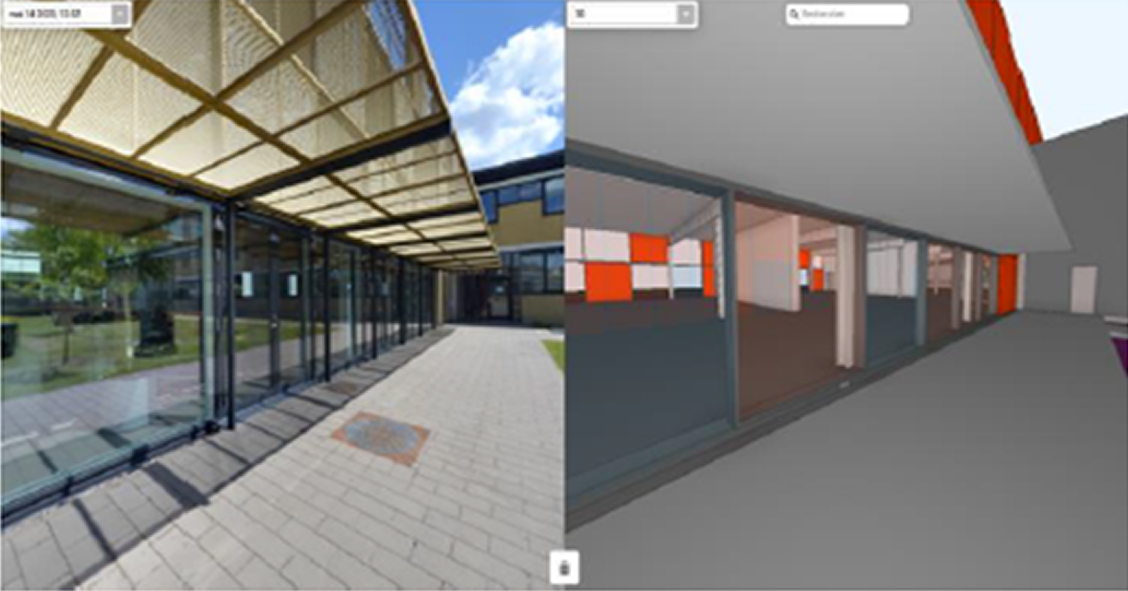
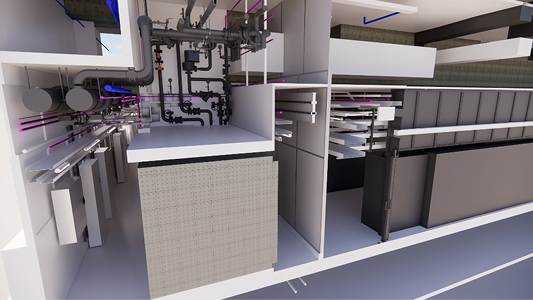
- Visualizing and anticipating the physical layout of equipment to plan IT room layouts.
- Evaluating different data center layout scenarios based on design choices, and making rearrangements if necessary.
- Generating high-quality images for detailed facility documentation, including schematic floor plans.
- Conducting virtual and guided tours of data centers to offer clients an immersive and interactive experience.
- Simulating growth scenarios and resource adjustments (power, cooling, electrical supply, connectivity, etc.) based on demand and technical constraints.
2. Physical digital twin (3D): BIM integration and environmental databases
Energy consumption and environmental impacts (CO2, biodiversity, water, etc.) are essential issues for the entire digital sector, including data centers. In France, the digital footprint currently represents 2.5% of France's total annual carbon footprint, or 16.9 Mt CO2 eq (Ademe and ARCEP, 2022). The annual electricity consumption induced by digital goods and services in France is 48.7 TWh, equivalent to approximately 10% of France's annual electricity consumption.
To effectively reduce these impacts, energy consumption must of course be optimized during the operational phase, but it is essential to take action from the upstream specification and design phases.
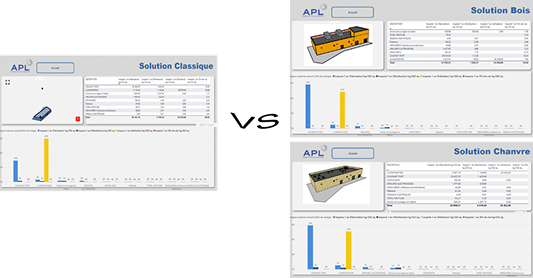
The BIM digital model of the building serves as the foundation for creating the 3D digital twin of the data center to simulate and optimize this consumption during the design and operational phases. Furthermore, linking this model with environmental databases, such as NegaOctet, enables determining the environmental impacts of the data center based on construction material choices from the project's early stages, rather than after the fact.
3. Functional digital twin (1D): PUE calculation
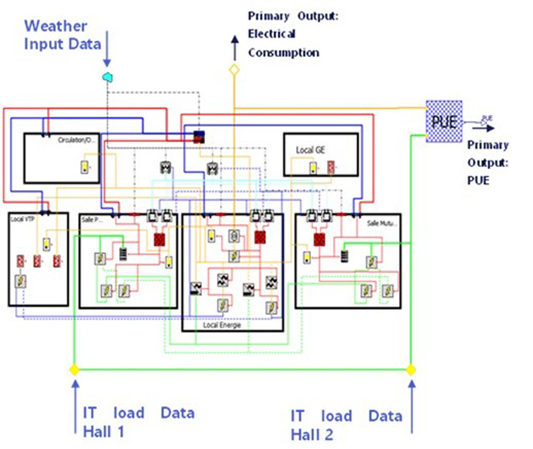
PUE (Power Usage Effectiveness) represents the most widely recognized and used standardized indicator in the data center ecosystem. It measures the energy efficiency of a data center's technical infrastructure. It is the ratio between the site's total consumption (kWh) and the IT equipment consumption (kWh). This metric enables anticipating direct financial impacts related to energy costs, and indirect financial impacts related to the data center's loss of attractiveness.
To reliably calculate PUE, digital twins also prove useful, particularly the functional digital twin. Indeed, PUE estimation is complex because it requires calculations depending on a large number of parameters: server and associated technical equipment occupancy rates, weather conditions, operating mode, regulation, etc. The functional digital twin enables performing these calculations automatically "on the fly."
The data center is represented as interconnected modules, which include equipment or groups of equipment with customizable parameters to accommodate data provided by manufacturers, weather data, and IT/telecom equipment load factors. The digital twin enables calculating the electrical consumption of each piece of equipment and the entire installation, facilitating the derivation of the PUE value. It facilitates the evaluation of different configurations of the data center's technical infrastructure as a whole or specific types of equipment in particular. This enables identifying the configuration that, at identical power (electrical or cooling), achieves the best energy efficiency.
4. Mix of functional and physical digital twin: airflow simulation
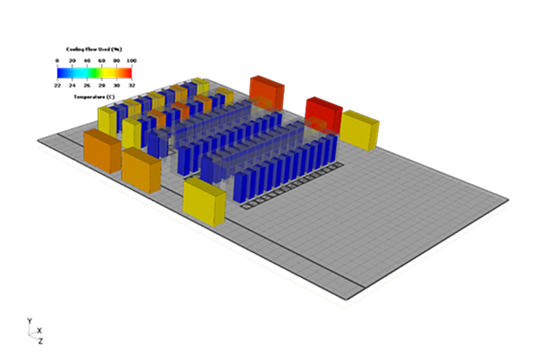
In the context of data center design, numerical simulation of airflow validates the resilience level of air conditioning systems from an aerodynamic perspective. Evaluating cooling capacity helps define or verify the available cooling power in the room, taking into account air characteristics and equipment selections. This approach considers supply and return air temperature, room humidity, and airflow.
In this scenario, the digital twin can be used to simulate and analyze thermal and fluid behavior inside the data center. It enables engineers to test different cooling scenarios, equipment layouts, and even predict thermal performance in case of modifications or additions to the existing infrastructure. Successive simulations, enabled by the digital twin, are performed according to the principle of parametric CFD (Computational Fluid Dynamics) simulations. The principle consists of modifying a single parameter, finding its optimal value, then moving to the next parameter. Following the step-by-step method, each parameter is adjusted sequentially to isolate the most relevant optimization factors. Once each optimal parameter is identified, they are compiled into a comprehensive CFD model, serving as the basis for subsequent studies.
Discover our white papers
Through our analyses and feedback, APL Data Center shares its expertise to support your decisions and anticipate industry developments.

You might also be interested in
Our services
Consulting - Data Center Strategy
Design & Construction - Engineering
You are planning to build, transform, or optimize a a data center?
Would you like to learn more about the benefits of digital twins?