
Eco-design of digital services: GreenConcept program review
Why is there so much talk about digital service pollution?
According to a survey conducted by Ipsos/Sopra-Steria, the environment is the primary concern of the French. It is therefore natural that public opinion and businesses have become more interested in the impact of the digital sector.
It should be noted that the entire digital sector is responsible for 4% of greenhouse gas emissions worldwide. This sector relies in part on the electronics industry, which is one of the most resource-intensive per unit of production: in energy, raw materials, rare metals, water, etc. All these elements are the source of numerous environmental and social impacts throughout the production chain. For example, manufacturing a laptop requires 700 kg of raw materials and a smartphone 200 kg.
What can be done to reduce this pollution?
To combat digital pollution, the first weapon is to eco-design digital services. Eco-design is the integration of environmental issues into the design or redesign of a product or service, so that they consume less material, less energy and produce less waste. The advantage of eco-design is that this approach is standardized by ISO 14062 standards and is based on a method for measuring environmental impacts that is itself standardized by ISO 14040 and ISO 14044, life cycle analysis (LCA).
What does this mean in practical terms?
In practical terms, it involves identifying the different components of a product or service in order to measure the weight of each in terms of greenhouse gas emissions, water consumption, energy and rare resources, and reducing it by optimizing its design and operation.
The GreenConcept operation represents a good example of the practical implementation of eco-design for digital services. In 2016, the Chamber of Commerce and Industry of Occitanie launched this program, supported by ADEME and the Region. This initiative aimed to support 30 regional companies in the eco-design of their digital products and services.
To carry out this project, 3 consulting firms, Neutreo by APL, LCIE and GreenIT.fr, came together and combined their expertise to jointly develop a simplified life cycle analysis method, easily applicable to digital services of all types. The companies, which represent a very broad range of business sectors (industry, health, education, communication, agriculture, transportation, construction, services), each benefited from 7 days of support to improve the environmental impacts of one of their digital products or services.
Three years after its launch, what are the results of the GreenConcept operation?
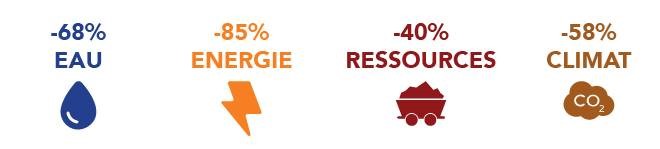
The results of this operation are more than positive: 28 companies were supported in eco-designing their digital service using the same method, the same rules and indicators.
On average across all 28 projects, the reduction in environmental impacts was more than 60%, meaning that for the same service provided, it is possible on average to divide the resources mobilized by 3.
Fifty eco-design best practices have been identified and are presented in the white paper we have just published GreenConcept 2020 White Paper
The main conclusions of the life cycle analyses carried out show that:
- The primary source of environmental impact is at the terminal level, essentially during the manufacturing phase, which accounts for between 30% and 60% of environmental impacts depending on the indicators.
- The data center/cloud component represents between 30 and 45% of environmental impacts.
Companies participating in GreenConcept were also able to observe other benefits related to implementing this environmental approach, such as strengthening their competitiveness and better visibility (awards, fundraising), etc.
It is important to note that the greatest levers for reducing digital pollution are at the level of defining the economic model of digital services; integrating the functional economy from the design stage is a strong axis for the development of sustainable IT.
What are the limitations of eco-design?
GreenConcept made it possible to measure the potential offered by eco-design; however, two limitations to this approach should be kept in mind:
- On the one hand, a "rebound effect" can often be observed associated with the release of resources offered by eco-design. It is therefore essential to ensure that the functional economy does not lead to overconsumption.
- On the other hand, eco-design is one of the levers for combating the environmental footprint of digital technology; there are others, particularly raising awareness of digital sobriety.
What are the next steps for APL?
Following the GreenConcept operation, we all wanted to go further in developing a robust database and a method for evaluating the environmental impacts of digital services. This is why we set up the NégaOctet research and development project, winner of the "Perfecto" call for projects launched by ADEME.
The ambition of NégaOctet is to propose a standardized method (subject to validation by experts external to the project) to measure the environmental impacts of digital services: streaming, online gaming, business applications, blockchain, big data, collaborative tools... because to be able to improve and propose other concrete actions, the first step lies in the objective and transparent measurement of its impact.
Discover our white papers
Through our analyses and feedback, APL Data Center shares its expertise to support your decisions and anticipate industry developments.

You might also be interested in
Our services
Consulting - Data Center Strategy
Design & Construction - Engineering

You are planning to build, transform, or optimize a a data center?
Would you like to learn more about the benefits of digital twins?